



ADL
ADL Overview
ADL Basic Concepts
Description
Reference
Task
Advanced concepts
Case Studies
Description
Task
Building your first algo
Lessons
Introduction to ADL
Description
Reference
Task
Videos
Arithmetic blocks
Basic blocks
Discrete blocks
Group blocks
Jump blocks
Library blocks
Logic blocks
Miscellaneous blocks
Trading Blocks
Virtualized blocks
APIs
TT .NET SDK
Advanced Concepts and Options
Appendix
Creating the application framework
Getting started with TT .NET SDK
Subscribing for market data
More about prices
An in-depth look at the Price class
Working with Algos
Algo Server
TT Order Types
TT Premium Order Types
Working with instruments
Working with orders and fills
Handling trade subscriptions
Working with trade subscriptions
TT CORE SDK
Appendix
Creating a TT Application Server
Creating Application Framework
Getting Started with TT Core SDK
Subscribing for Market Data
Working With Instruments
Working with Orders and Fills
TT REST API 2.0
API Reference
Getting Started
TT REST API 2.0 (UAT)
API Reference
Getting Started
Data and Analytics
TT Margin
MiFID II Support
Monitor
Setup
Company Administration
Account Administrators
Description
Task
Accounts
Description
Reference
Task
Use Cases
Videos
Advanced Features
Description
Company
Description
Reference
Task
Connections
Description
Reference
Task
Videos
Order Tag Defaults
Description
Task
TT Access
Description
Task
TT Premium Services
Description
Task
Users
Description
Reference
Task
Videos
Exchanges: Americas
B3
Description
Task
CBOE
Description
Task
Cboe FX
Description
Reference
Task
CFE
Description
Task
CME
Description
Task
Dealerweb
Description
Task
EBS Direct
Description
Task
EBS Market
Description
Task
Fenics
Description
Task
FMX
Description
Task
FMX_USTF
Description
Task
Goldman Sachs Commodity Blocks (GSCB)
Description
Referece
Task
ICE
Description
Task
MexDer
Description
Task
MIAX_FUT_CH
Description
Task
MIAX_FUT_NY
Description
Task
MX
Description
Task
NFI
Task
Nodal
Description
Task
Exchanges: Asia/Pacific
ABX
Description
Task
ASX
Description
Task
CoinFLEX
Task
FEX
Description
Task
HKEx
Description
Task
JPX
Description
Task
NSE
Description
Task
NZX
Description
Task
SGX
Description
Task
SGX GIFT
Description
Task
TAIFEX
Description
Task
TFEX
Description
Task
TFX
Description
Task
Exchanges: Crypto
Coinbase
Description
Task
Kraken
Description
Task
Exchanges: EMEA
ATHEX
Description
Task
BIST
Description
Task
CEDX
DGCX
Description
Task
EEX
Description
Task
EPEX SPOT
Description
Reference
Task
Eris
Description
Task
Eurex
Description
Task
Videos
Euronext
Description
Task
GFO-X
Description
Task
ICE_L
Description
Task
JSE
Description
Task
LME
Description
Task
LME NTP
Description
Task
LSE
Description
Task
MEFF
Description
Task
NASDAQ_NED
Description
Task
NDAQ_EU
Description
Task
Nord Pool
Description
Reference
Task
WSE
Description
Task
FIX Support
FIX Ruleset
Description
Task
FIX Sessions
Description
Task
Secondary Accounts
Description
Task
Risk Management
KRM Limits
Description
Task
Order Cross Prevention
Description
Task
Videos
Pre-Trade Portfolio Risk
Description
Reference
Task
Risk Administration
Description
Task
Risk Limits
Description
Reference
Task
Videos
Setup Overview
Getting Started
Description
Reference
Task
Videos
Supported Order Types and TIFs
TT® OMS
TT OMS Administration
Description
Reference
Task
Use Cases
Trade
Algo Trading
Algo Dashboard
Description
Reference
Task
Videos
Autotrader
Description
Reference
Task
Videos
Excel integration with TT
Description
Reference
Task
Videos
Market-Making Algos
Order Management Algos (OMAs)
Template Manager
Description
Task
Analytics
Charts
Description
Reference
Task
Technical Indicators
Videos
Trader Analytics
Description
Reference
Task
Basic Order Entry
Blocktrader
Description
Reference
Task
Videos
MD Trader®
Description
Reference
Task
Videos
Order Profiles
Description
Reference
Task
Order Ticket
Description
Reference
Task
Use Cases
Routing Rules
Description
Task
Trading Crypto on TT
Description
Reference
Task
Videos
Trading on B3
TT Order Types
Case Studies
Description
Reference
Task
Videos
TT Premium Order Types
Description
Reference
Task
Options
Counterparty Manager
Description
Task
Electronic Eye
Description
Reference
Task
Videos
Expiration Manager
Description
Task
Options Chain
Description
Reference
Task
Use Cases
Videos
Options on TT
Description
Videos
Options Risk
Description
Reference
Task
Videos
Options Risk Matrix
Description
Reference
Task
Videos
Options Trade Monitor
Description
Reference
Task
Videos
QuikStrike
Description
Task
RFQ Viewer
Description
Reference
Task
Videos
RFQ with Counterparties
Description
Task
Strategy Creation
Description
Reference
Task
Use Cases
TT Uncovered
TT Uncovered 2.0
Description
Task
TT Uncovered 3.0
Description
Task
Vol Curve Manager
Description
Reference
Task
Use Cases
Videos
Volatility Calculator
Description
Task
Watchlist
Description
Reference
Task
Videos
Order Management
Account & User Restrictions
Description
Reference
Task
Account List
Description
Reference
Task
Videos
Alert Manager and Alert Viewer
Description
Reference
Task
Videos
Audit Query
Description
Reference
Task
Audit Trail
Description
Reference
Task
Balances
Description
Reference
Task
Fills
Description
Reference
Task
Floating Order Book
Description
Reference
Task
Order Book
Description
Reference
Task
Orders and Fills
Description
Reference
Task
Position Manager
Description
Reference
Task
Positions
Description
Reference
Task
Overview
Browser Access
Description
Task
Videos
Preferences
Description
TT Desktop
Description
Reference
Task
Videos
TT Platform
Description
Task
Widgets
Description
Task
Workspace Windows
Description
Task
Videos
Spread Trading
Aggregator
Description
Reference
Task
Videos
Autospreader
Description
Reference
Task
Use Cases
Videos
Autospreader Rules
Description
Reference
Task
Videos
Hedge Manager
Description
Reference
Task
Videos
Trading in Yield
Description
Reference
Task
Use Cases
TT® OMS
Bulking
Description
Task
Videos
Care Orders
Description
Reference
Task
Videos
Combining
Description
Task
Lock and Release
Description
Task
Order Exceptions
Description
Task
Order Passing
Description
Task
Use Cases
Stitching and Splitting
Description
Task
Viewing Market Data
Depth
Description
Reference
Task
Market Grid
Description
Reference
Task
Videos
Product Grid
Description
Reference
Task
Spread Matrix
Description
Reference
Task
Videos
Time and Sales
Description
Reference
Task
TT Backtesting
TT FIX Services
TT FIX Drop Copy In
Overview
Supported application messages
TT FIX Drop Copy Out
Compliance Feed messages
Overview
Supported application messages
TT FIX Message Conversations
TT FIX Gateway
Components
FIX Message Structure
Getting Started
Order Gateway Messages
Price Gateway Messages
Session messages
TT FIX General
FIX Message Structure
Getting Started
Session messages
TT FIX Market Data
Overview
Supported application messages
TT FIX message conversations
TT FIX Order Routing
Overview
Supported application messages
TT FIX message conversations
TT FIX Recovery
Compliance Feed Messages
FIX Recovery Methods
Overview
Supported application messages
TT Mobile
TT Trade Surveillance
Cluster View
Configurable Models
Core Models
Cross Product Models
Improperly Matched Trade Models
Market Abuse Models
Market Rate Models
Miscellaneous Models
Spoofing Models
Trading Behaviors Models
Overview
Reference
Reports
Using TT Trade Surveillance
Wachlists

Order Passing Overview

On this page

The Order Book widget supports order passing, which allows traders to pass the visibility and management of open, working orders to another trader or group of traders. Passing an order to another “caretaker” ensures the order is executed and managed correctly while not being watched by the originator of the order. While the pass is performed, the order continues to work and position in queue is maintained.

Traders and groups can perform the following roles when passing or accepting orders:

  • Originator — User who placed the original order.
  • Caretaker — User or group that is monitoring an order that they did not place.

Note: The orders pane of the Order and Fills widget also supports order passing.

How Order Passing works

Order passing is configured on a user group level by your administrator using Setup in TT. Order passing occurs when a trader in one user group initiates order passing to another user group. A trader cannot “pull” an order from another group.

While an order is being watched by a caretaker group, the order originator and all traders sharing the account with the originator have full visibility of the order, and see updates and partial fills as they occur. Control of a passed order is shared by both user groups, allowing either group to take immediate action on the order as needed.

Note: When passing an order, the two groups do not need to share accounts.

There is no disruption to an order during the passing process. Passed orders continue to work in the market and retain their position in queue throughout all steps of the passing process (pending pass, accept, reject, undo, etc.). The order originator remains the user who originally placed the order.

Risk remains with the account used to submit the order and follows the order as it is passed. The caretaker of an order can change the price or quantity of the order based on the account’s risk settings.

To pass and accept orders, refer to Passing and Accepting Orders. For an example of order passing, refer to Night Desk Support.

Order passing support in the Order Book

The Order Book widget displays the following to support order passing:
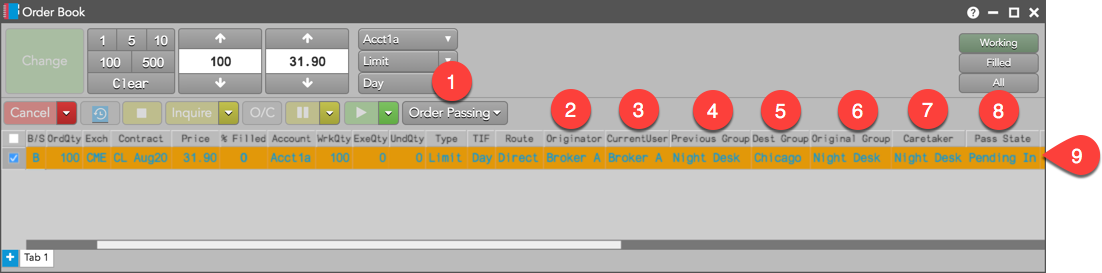
Note: The button and columns are optional and can be shown in Settings: Order Book using the right-click context menu.

  1. Order Passing button — An optional button on the Order Toolbar that is used by the originator to pass an order, and used by the caretaker to accept or reject a passed order from the originator. Click the button’s drop down arrow for a list of actions:
    • Pass orders: Passes an order to a user group. You can only pass orders to a group that has an order passing relationship set up with your group.
    • Accept: Accepts an order passed from an originator or other caretaker.
    • Reject: Rejects a passed order.
    • Undo Pass: Cancels the caretaker selection.
  2. Originator — Identifies the user who submitted the order.
  3. CurrentUser — Identifies the user who is currently monitoring the order.
  4. Previous Group — Shows the name of the user group that previously accepted, rejected, or worked the order and passed it to another group. When shown, this column is blank until an order is passed.
  5. Dest Group column — Identifies the target order passing group that you are passing the order to. When shown, this column is blank until an order is passed.
  6. Original Group column — Identifies the order passing group that initiated the order pass. When shown, this column is blank until an order is passed.
  7. Caretaker column — Identifies the user group monitoring an order. If no order was passed, this column is blank. For the caretaker’s group, this column shows the group that passed the order to them. Their group name is highlighted until the order is accepted. After accepting a passed order, the Caretaker column displays the name of the current group that is managing the order. The value in this column is visible to both the group passing the order and the group accepting the order.
  8. Pass State column — Shows the state of a passed order. Two states are possible:
    • Pending Out: Indicates that you passed an order to a user group, but the order hasn’t been accepted yet. The column goes blank after you undo an order pass.
    • Pending In: Indicates another user group passed an order to you and is pending your acceptance. The column goes blank after you accept or reject an order pass.
  9. Order Book rows for passed orders — Orders in a pending pass state (i.e., pass has been initiated but not yet accepted) will auto sort to the top of the book and be identified by a light orange background color. Passed orders that are filled will automatically sort to the bottom of the Order Book widget and be displayed in italics with faded colors.

Order Passing Sounds

The following sounds can be enabled in the Orders section of the Preferences | Sounds page.

  • Pass Request — Plays on the workstation of the target group when a passed order arrives for that group. “Default = Notify”. Enabled by default.
  • Pass Reject — Plays on the workstation of the target group when a passed order is rejected by that group. “Default = Down”. Enabled by default.

Full or partial fills sounds enabled in the Fills section of the Preferences | Sounds page will play for the Caretaker who accepted the pass and filled the order. The fills sound will not play for pending/rejected passed orders.

This site is registered on wpml.org as a development site. Switch to a production site key to remove this banner.